Ole Kirk Christiansen's Wooden Workshop and the Brick That Replaced It
From a Billund joinery bench in 1932 to a patented plastic coupling that has held for seven decades
The Carpenter Who Would Not Change Trades
Ole Kirk Christiansen was a joiner by training, operating a small furniture and household-goods workshop in Billund, a market town in the Jutland peninsula of central Denmark. The workshop had made window frames, ladders and ironing boards; by the early 1930s, in the economic contraction following the Depression, commissions had dried to the point where the firm needed a supplementary line. Christiansen turned to wooden toys — miniature trucks, animals, yo-yos — and in 1932 formally committed the workshop to their production. The name LEGO was adopted in 1934, a contraction of the Danish leg godt, meaning "play well," though Christiansen later learned that the Latin lego also carries the sense of "I put together," a coincidence the firm has acknowledged without overclaiming.
The Billund operation remained small through the 1930s, selling domestically through travelling salesmen. Production was entirely in wood: beech and pine, shaped by hand tools and simple jigs, finished with paint and lacquer. A fire destroyed the workshop in 1942 and again in 1951 — the second fire taking the wooden toy stock — but both times Christiansen rebuilt, and the second reconstruction was the moment that definitively accelerated the shift to plastic. A wooden toy inventory lost to fire is a catastrophic write-down; an injection-moulded range requires only that the steel mould tools survive.
The LEGO factory at Billund had acquired its first injection-moulding machine in 1947, a British-made Triton, and with it began producing a range of plastic items alongside the wooden catalogue. Among the first plastic products was a small interlocking brick, loosely based on Hilary Page's Kiddicraft Self-Locking Brick, which itself carried a British patent from 1939 and 1947. The LEGO brick of 1949 — marketed in Denmark as the Automatik Mursten, or Automatic Brick — interlocked by stud over stud but lacked a complementary tube on the underside. The coupling was imprecise, the release too easy or, in warm conditions, too stiff. Retailers returned the bricks in quantity, and for years the brick remained a side-line rather than the firm's core proposition.
Godtfred and the System Argument
Ole Kirk Christiansen's third son, Godtfred Kirk Christiansen, had entered the firm as a teenager in the 1940s and by the early 1950s was effectively its commercial director. Where his father's instinct was a craftsman's — make a good object, price it honestly — Godtfred's was a systems thinker's. In 1954, following a conversation with a buyer from a Danish wholesale firm about the absence of a unifying concept in the toy market, Godtfred drafted what he later described as the criteria for a system of play: it should be limitless in combination, consistent in scale, and compatible across years of production so that a set bought in one year could be extended in the next. The argument Godtfred Kirk Christiansen made internally settled on the plastic brick as the vehicle for that system — but only if its coupling could be made reliable.
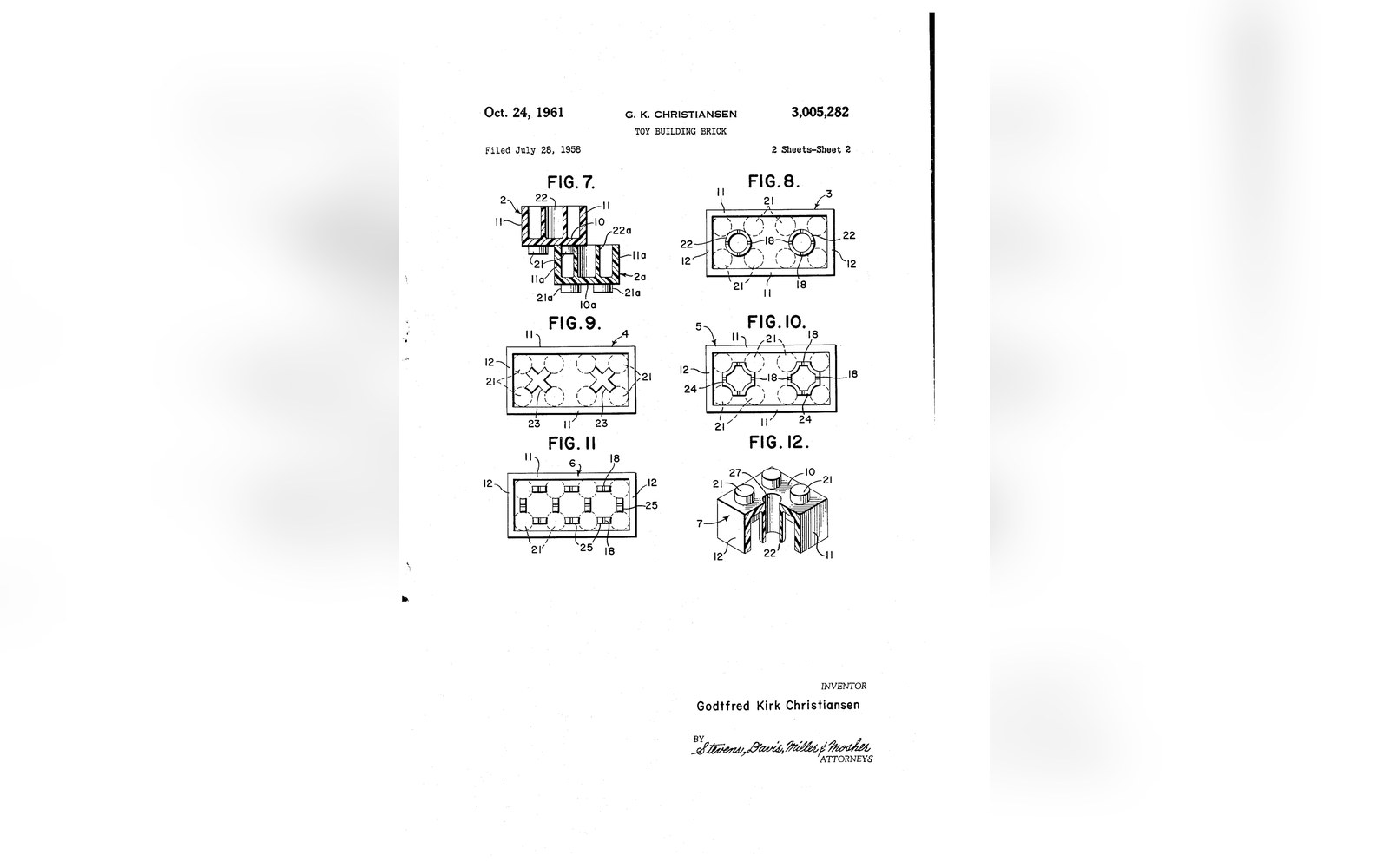
The engineering problem was interference fit: two parts must grip firmly enough to stay joined under play forces, yet release without tools. The 1949 brick's solid studs pressing against a flat underside offered no defined tolerance, only friction. Godtfred's solution, developed with the firm's pattern-maker and tested through 1957, was the addition of hollow tubes — counterbores — inside the underside of each brick, positioned so that the studs of a brick below engaged both the outer walls of the shell and the inner surfaces of the tubes simultaneously. This three-point contact geometry distributed the coupling force and made it consistent regardless of ambient temperature, provided the material's own dimensional behaviour was sufficiently stable.

That last condition drove the ABS decision. The bricks had been moulded in cellulose acetate, a thermoplastic derived from plant cellulose that absorbed moisture and changed dimension accordingly. Acrylonitrile butadiene styrene, introduced into the brick's production specification in 1963, offered the dimensional stability that cellulose acetate could not deliver: ABS's moisture absorption is low enough, and its shrinkage from the mould predictable enough, that the interference fit — the clutch power the system depends on — can be held to tolerances tight enough to survive in a child's hands without tools for separation.
The stud-and-tube interlocking system was filed as a Danish patent on 28 January 1958, and that date has stood as the definitive point of origin for the modern LEGO brick as a designed, engineered artefact rather than an adapted import. The 1958 patent ↗ specified not just the geometry of the coupling but the dimensional relationships between stud diameter, tube diameter, and brick-wall thickness that defined compatible manufacture. Ole Kirk Christiansen died two months after the patent was filed, in March 1958, and did not see the document registered.
Material Change, Industrial Scale
The transition from cellulose acetate to ABS in 1963 was not merely a materials substitution; it was the point at which the LEGO brick became a precision-manufactured part in the engineering sense. The mould tools required to hold ABS to the necessary tolerances are hardened to Rockwell standards that place them among the most exacting tooling in consumer-goods manufacture. Each tool cavity is machined to account for the predictable shrinkage of ABS on cooling, so that the finished part emerges at the intended dimension rather than the cavity's dimension. The capital cost of a single mould tool runs to figures that, for a small firm, would have been prohibitive — one reason why the system's scaling through the 1960s required the commercial success of the early System sets to fund the tooling programme.
LEGO's Billund site, operating continuously since Ole Kirk Christiansen's original rebuilding, remains the firm's primary manufacturing and headquarters location. The Nuremberg Toy Fair was the first international exhibition at which LEGO bricks appeared as a complete system, in the late 1950s, and the reception there established the export market that turned a Danish regional toy-maker into a global manufacturer. The wooden toys — the ducks, the trucks, the yo-yos Ole Kirk Christiansen had made to keep his joinery firm afloat — were discontinued in 1960, eight years after the shift to plastic had begun and two years after the patent that made the brick's geometry fixed. The bench in Billund had not changed trades after all; it had simply found that its best product was made of something other than wood.