Godtfred Kirk Christiansen and the System of Play
How a 1954 argument about compatible parts restructured LEGO from a toy manufacturer into a design doctrine

The Argument Made in 1954
Godtfred Kirk Christiansen arrived at the idea that would define LEGO's commercial identity not in a factory or a design studio but during a sea voyage, in conversation with a buyer from a Danish department store named Magasin du Nord. The buyer's complaint was straightforward: the toy trade offered no coherent system, only a fragmented accumulation of individual products with no logical relationship to one another. Godtfred — the third son of Ole Kirk Christiansen, by then managing the day-to-day operations of the Billund firm his father had founded in 1932 — turned the observation into a formal internal argument.
By 1954 he had written it down: LEGO's competitive advantage would not be any single product but the compatibility between products. Sets would interlock, literally and conceptually. A child purchasing one box would not be starting again with the next; they would be extending a system. He called this the System i Leg — System of Play — and it became the organising principle against which every subsequent product decision was tested.

This was not merely a marketing position. It was a manufacturing and engineering commitment with immediate material consequences. For the system to function, every LEGO element produced in 1954 had to couple reliably with every element produced in 1974 and, by extension, with every element produced thereafter. That promise demanded dimensional tolerances far tighter than anything then standard in the toy industry. It also meant that no element could be quietly redesigned for cost reasons without threatening the entire system's backward compatibility. The doctrine was, in engineering terms, unusually demanding.
The 1958 Patent and What It Encoded
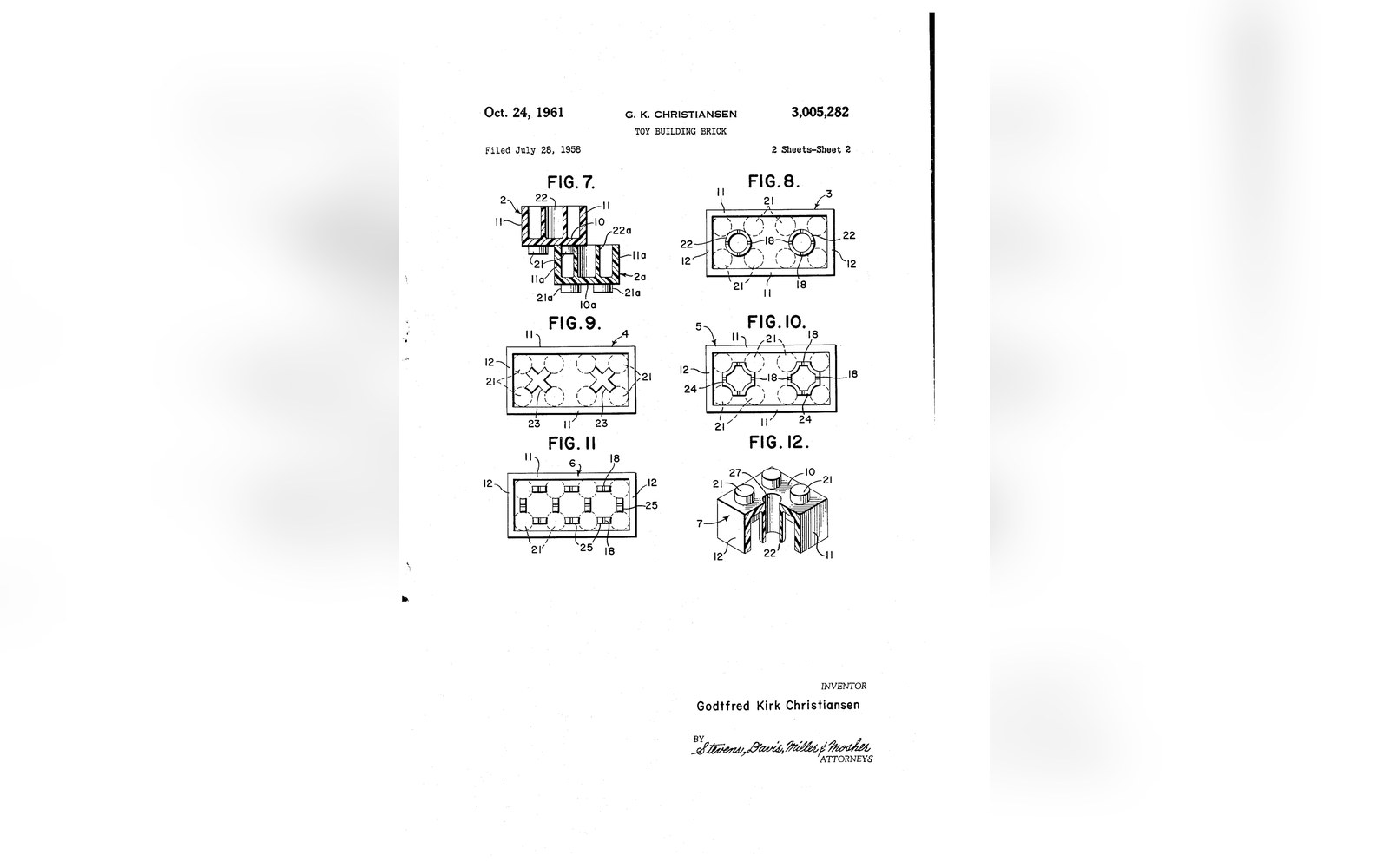
The formal expression of the System of Play arrived in the stud-and-tube locking geometry patented on 28 January 1958 ↗. The 1954 principle needed a physical mechanism capable of delivering it reliably, and the existing stud-on-stud brick — which the firm had been producing since 1949, itself derived from a 1947 Kiddicraft design by the British inventor Hilary Fisher Page — did not provide adequate clutch power. It held bricks together loosely and offered no structural precision.
The solution engineered at Billund was the hollow central tube running inside each brick's interior, which engaged the studs of the brick below and distributed the coupling force around a larger contact surface. The result was a measured, repeatable resistance: firm enough to hold structures together during play, light enough to disassemble by hand without tools. LEGO later formalised this as clutch power, and its maintenance to consistent tolerances — achievable only in a dimensionally stable engineering plastic — was what made the system materially viable.
The transition from cellulose acetate to ABS in 1963 was not incidental to the System of Play: it was demanded by it. Cellulose acetate absorbed moisture, swelled unpredictably, and could not be held to the tolerances necessary for consistent clutch. ABS, with its dimensional stability and compatibility with high-precision injection moulding, made the system's backward-compatibility promise physically tenable across production runs and across years. The material choice was a doctrinal decision as much as a manufacturing one.
This architecture produced several durable consequences.
The Doctrine as Business Architecture
What Godtfred Kirk Christiansen established with the System of Play was something the toy industry had not previously formalised: a platform. In the language later applied by technology historians and business strategists, LEGO became a platform before that term existed in its contemporary sense. The individual set was not the product; the system was the product, and the set was an entry point into it.
This architecture produced several durable consequences. First, it created switching costs without lock-in by deception — a buyer remained in the LEGO system not because they were trapped but because their existing investment in elements continued to generate value. Every new set expanded the usable universe of the one before it. Second, it placed the mould tool — the hardened steel injection mould cavity that represents the principal capital investment in volume toy manufacture — at the centre of company strategy. Because elements had to remain compatible indefinitely, retiring a mould and introducing a geometrically incompatible replacement carried a cost well beyond the tooling budget: it threatened system coherence.
Third, the doctrine imposed a conservative discipline on product development. New element types could be introduced only if they coupled with existing ones. Entirely new geometries required explicit justification against the compatibility test. When LEGO introduced the minifigure in 1978, the figure's proportions and stud-socket feet were designed to engage directly with standard bricks and plates — compatibility was not an afterthought but a design criterion. The same logic governed the introduction of Technic beams with their axle-hole geometry, and later the DUPLO range, whose larger elements accept standard LEGO studs on their upper surfaces so that the two systems connect in one direction.
The tension in this architecture — between system coherence and product innovation — was a live engineering and commercial question throughout Godtfred's tenure as managing director and beyond. He stepped back from day-to-day management in 1979, handing operational leadership to his son Kjeld Kirk Kristiansen, but the framework he established survived the transition intact. The Billund factory continued to be organised around the compatibility standard rather than around individual product lines.
What the Doctrine Did Not Resolve
The System of Play solved the problem of coherence between products but left open the question of coherence between themes. As LEGO's licensed range expanded through the 1990s and 2000s — Star Wars elements in 1999, Harry Potter in 2001 — the system's physical compatibility was maintained while its conceptual unity diversified. Elements remained interchangeable, but the imaginative world each set invoked was proprietary in a different sense: it belonged to a licensor's intellectual property.
Godtfred Kirk Christiansen's 1954 formulation had assumed that the system's internal logic — the compatibility of parts — would itself supply the imaginative framework. A brick was a brick; what it could become was open. Licensed themes introduced a specific narrative into what had been a deliberately open-ended system. This was not a failure of the doctrine but a test of how far physical compatibility could carry a design philosophy when the surrounding culture had changed.
The Nuremberg Toy Fair ↗ provided the international stage on which LEGO's system positioning was repeatedly demonstrated from 1950 onward, and it was in that competitive context that the System of Play's practical advantages over fragmented competitor ranges became commercially legible. Buyers could see, on a single stand, how the elements from one set extended those from another — a visible argument that no individual product demonstration could make on its own.
The concept Godtfred Kirk Christiansen articulated on that sea voyage in 1954 was, in essence, that the space between products mattered as much as the products themselves. Forty years of production history confirmed that the argument was correct, and the stud-and-tube brick, held to tolerances measured in hundredths of a millimetre, was the object that proved it.