Margarete Steiff and Richard Steiff: What Each One Made
Two people, one firm — but their contributions were not the same thing.
The Seamstress and the Sculptor
Margarete Steiff founded her workshop in Giengen an der Brenz, in the Swabian district of Baden-Württemberg, in 1877, initially producing felt clothing and then a small felt elephant, designed as a pincushion but sold, as the company's own records document, primarily as a child's toy. She had worked as a seamstress despite contracting polio in infancy, which left her without the use of her legs, and her precision with fabric and pattern was the firm's founding competence. The elephant, drawn from a pattern in a fashion magazine, was not conceived as the beginning of a toy empire; its commercial success made it one. By the 1890s, the Steiff workshop — by then a family enterprise in the fullest sense — was producing a range of felt and plush animals, all shaped by Margarete's instinct for material quality and her workers' needlecraft.
Her domain was the workshop floor: material selection, production standards, and the commercial judgment that held quality above volume. The mohair plush and excelsior-stuffed animals that became Steiff's signature depended on that standard being maintained consistently across an expanding workforce. Margarete held it.
The Bear and the Fair
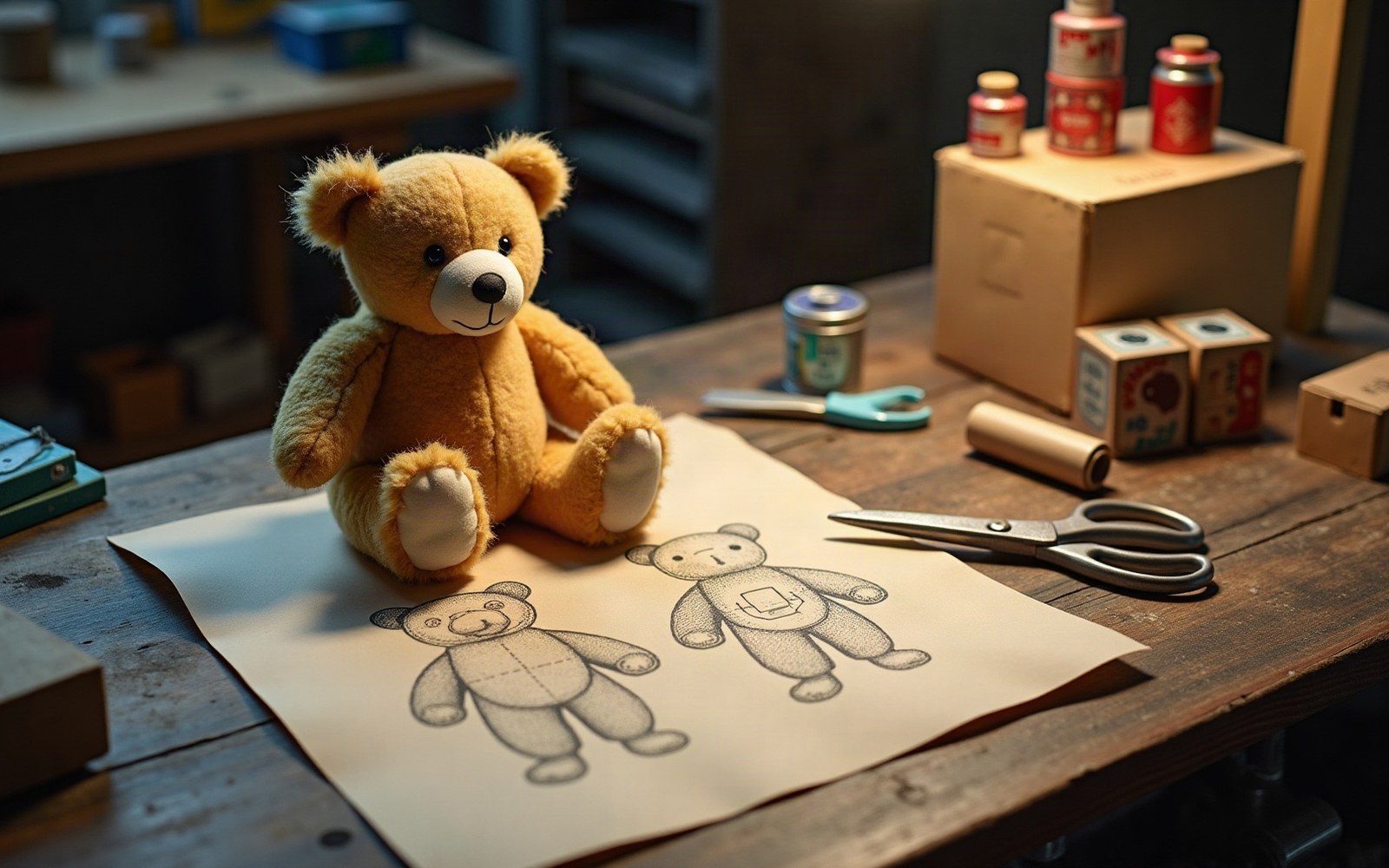
Richard Steiff, her nephew, brought a different discipline. Trained at the Kunstgewerbeschule in Stuttgart — a school of applied arts — he spent time sketching live bears at the Stuttgart Zoo, and those drawings became the basis for a jointed stuffed bear unlike the flat-backed, rigid-limbed animal toys then current. The jointing mechanism, which allowed the head, arms and legs to move independently, used a system of card discs and wire — later refined to hardened discs fixed by cotter pins, the construction documented in Steiff's 1905 German patent. The form was new; nothing in the firm's existing range anticipated it.
Richard brought his bear prototype to the Leipzig Toy Fair in the spring of 1903. Leipzig's spring trade fair ↗ was then the major European venue for buyers placing seasonal orders, and it was there that a large American order — attributed in multiple accounts to buyer Hermann Berg, representing the New York importer George Borgfeldt & Company — transformed what might have remained a workshop experiment into a production commitment. Exactly how large that order was is disputed in the sources, but its existence and its American destination are consistently recorded.


What Richard designed was the object. What Margarete's operation provided was the capacity to fulfil an order of that scale, to consistent quality, at commercial speed. These were not the same contribution, and collapsing them into one story loses the industrial reality.
What the Division Means for the Record
The historical record benefits from precision here because attribution in toy history frequently gravitates toward a single name. Margarete Steiff is correctly identified as the firm's founder; the button-in-the-ear trademark introduced in 1904 — the Knopf im Ohr — is registered to the firm she established. Richard Steiff is correctly identified as the designer of the jointed bear form. Neither claim displaces the other.
What Margarete did not do was design the jointed bear. What Richard did not do was build the production system, set the material standards, or run the business through which his design became manufacturable at scale. The bear reached the market because both things were in place: a form precise enough to be worth producing, and a workshop disciplined enough to produce it.
The distinction matters particularly when assessing later variants, licensed reproductions and museum-held specimens. A piece can be correctly Steiff in material and construction standard while being Richard's form; those are different claims about different things, and the historical record requires both.