Ruth Handler at the 1959 Toy Fair and the Resistance She Overcame
The Barbie doll reached the American International Toy Fair on 9 March 1959 over the objections of almost everyone in the room — and sold 351,000 units in its first year.
The Argument Inside Mattel
Ruth Handler had been developing the concept for several years before the doll was ready for market. Her starting observation was specific: girls playing with paper dolls were projecting adult scenarios onto them — careers, wardrobes, futures — rather than rehearsing the nurturing behaviour that infant dolls were designed to prompt. The toy industry had not yet manufactured that observation into a product.
Her husband Elliot Handler, co-founder of Mattel alongside Harold Matson, was unconvinced. His reservation was industrial as much as aesthetic: a hard-bodied, adult-proportioned fashion doll with injection-moulded vinyl construction and a wardrobe sold separately represented a more complex and expensive manufacturing proposition than the wooden and simple plastic items the company had built its early reputation on. Separate garments meant separate tooling, separate supply chains, and a retail model that depended on continued accessory purchase rather than a single transaction. The risk was structural, not trivial.
The doll itself was designed with the involvement of Jack Ryan, an engineer Mattel had recruited from the Raytheon defence contractor, whose background in precision mechanisms shaped the production tolerances. The figure's vinyl body was manufactured in Japan, where labour costs made the retail price viable; the design drew acknowledged inspiration from Bild Lilli, a German fashion doll sold from 1955, and Mattel later settled a lawsuit with Lilli's originator, the publisher Axel Springer Verlag, acquiring the rights to the design.
The Fair and Its Buyers
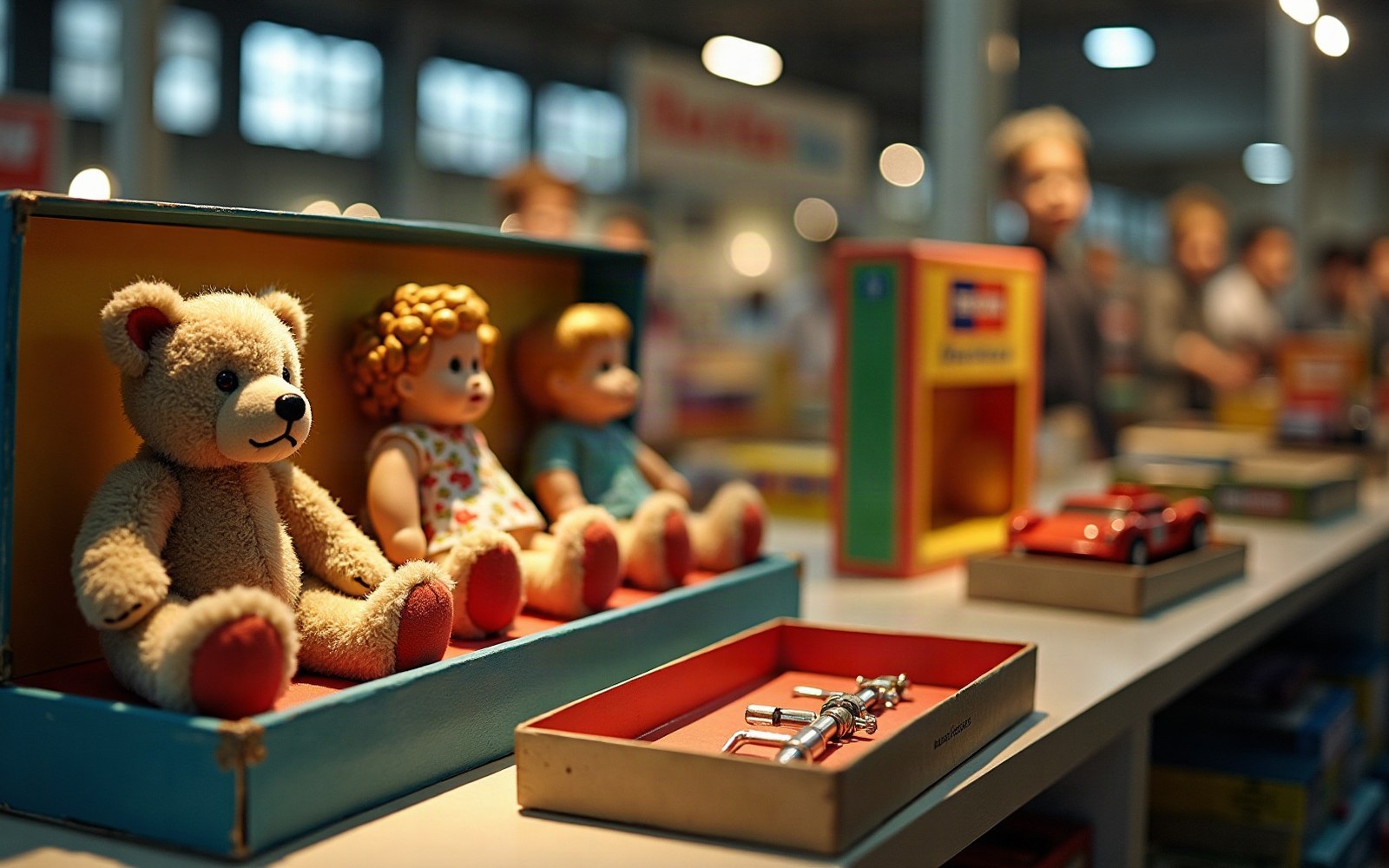
The American International Toy Fair, held annually in New York, was in 1959 the decisive arena in which a manufacturer's coming season was accepted or rejected by retail buyers. The buyers Mattel faced were predominantly male, as was the wholesale trade in general. Their professional instinct ran toward toys with clear, immediate play value — a resistance that was partly conservative and partly rational, since the accessory-purchase model for a doll's wardrobe had no strong precedent in the American mass market at that price point.

The doll Ruth Handler brought to the Fair on 9 March 1959 — the date now taken as Barbie's official birthday — wore a black-and-white zebra-stripe swimsuit and was named Barbara Millicent Roberts, after Handler's daughter. The buyer response at the Fair was, by documented accounts, cool. Orders were modest. The trade was not persuaded that American mothers would buy an adult-figured doll for their daughters, and several buyers said as much directly. The figure's proportions and the explicitly adult identity were precisely the features the market considered risky.
Mattel had already committed to a television advertising campaign aimed at children rather than the buyers or their parents — a strategy the company had pioneered with earlier products and that bypassed the retail buyer's aesthetic judgements entirely. The advertisements ran on the Mickey Mouse Club broadcast, reaching children directly ↗ in a manner that the trade show floor could not replicate.
What the Numbers Said
The argument was settled by the close of 1959. Mattel sold approximately 351,000 Barbie units in the doll's first year on the market, a figure that transformed the internal conversation at the company and validated the accessory model: the separately sold wardrobe — priced to encourage repeated purchase — proved the mechanism Ruth Handler had anticipated. By the early 1960s, Barbie's revenue stream from clothing and accessories was outpacing the doll itself, confirming that the structural risk Elliot Handler had identified was also, correctly understood, the structural opportunity.
The American International Toy Fair ↗ remained the venue through which successive Barbie iterations were presented to trade each year, and the 1959 debut became a documented case in the history of buyer resistance to genuinely novel product categories. What the buyers at the 1959 Fair had read as risk — an adult doll, a wardrobe sold separately, a television campaign over their heads — Ruth Handler had read as the product's logic. The first-year sales figure was the proof, and no further argument was needed.