Ernő Rubik's Cube: 1974 in Budapest, 1980 Everywhere Else
A structural model built to teach architecture students became the twentieth century's best-selling mechanical puzzle — but six years and a Cold War licensing negotiation stood between the prototype and the world.
From the Lecture Room to the Patent Office
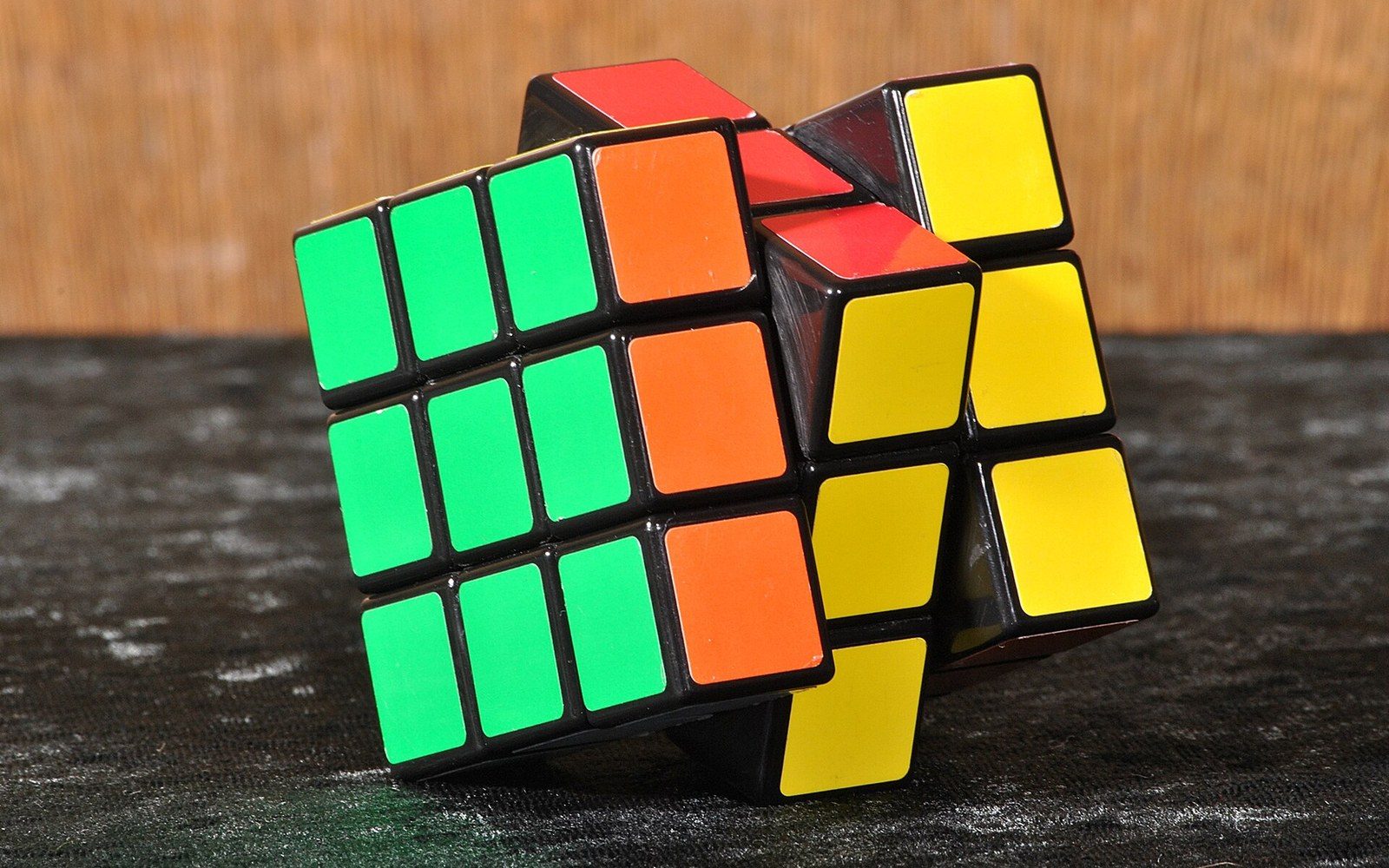
Ernő Rubik built his first working model in 1974 while teaching interior design and architecture at the Budapest College of Applied Arts. The object was not conceived as a toy. Rubik wanted a physical demonstration of how independent three-dimensional rotation could operate within a stable overall structure — a teaching aid that made spatial logic tangible. The twenty-seven smaller cubelets that composed his model were held together not by a frame or axle but by an internal pivot mechanism: a spherical core from which curved tracks radiated, allowing each layer of nine cubelets to rotate independently without the assembly collapsing. The geometry that made this possible — interlocking flanges on each cubelet's inner face that curved around the core's tracks — was the genuine engineering achievement. The coloured stickers on the outside were almost incidental.
Rubik filed for a Hungarian patent in January 1975, and the Magyar Szabadalmi Hivatal granted it under the designation HU170062. The patent described the object as a bűvös kocka, or magic cube. Domestic production began through Politoys, a Hungarian state enterprise, and the puzzle appeared in Budapest toy shops in 1977. Sales were strong enough within Hungary's planned economy to attract the attention of Tibor Laczi, a Hungarian-born businessman based in Austria, who encountered the cube at a trade fair and moved to broker its export licensing. Tom Kremer, a toys-and-games agent working out of London, subsequently took up the international rights. Together they brought the puzzle to the Nuremberg Toy Fair in 1979, where Ideal Toy Company, a New York-based firm, agreed to acquire international distribution rights.
The Six-Year Gap and What Filled It
The distance between Rubik's 1974 prototype and the 1980 international launch was not merely bureaucratic. Hungary was a member of the Warsaw Pact, and any export licensing of an invention by a Hungarian citizen required negotiation through state channels. The object also needed re-engineering for mass production: Politoys' domestic version used tolerances acceptable for a low-volume state-run run, but Ideal required a product that could withstand the rough handling of global retail. The cubelet geometry was refined, the internal tracks were tightened, and the stickers — always the puzzle's most vulnerable component, prone to peeling and fading — were standardised. Ideal also renamed it: internationally, the object launched as Rubik's Cube ↗, dropping bűvös kocka entirely and attaching the inventor's name in a way that has since made it inseparable from the object.
The mechanical pivot at the cube's heart is worth dwelling on. Each of the six faces is a three-by-three grid. The centre cubelet of each face is fixed to one of the six arms of the internal core; it can rotate in place but cannot move to another face. The eight corner cubelets and twelve edge cubelets move freely around the core when a layer is turned, held by the curved flanges rather than any adhesive or clip. The number of possible permutations of the fifty-four coloured faces — across all positions of the twenty movable cubelets — is 43,252,003,274,489,856,000, a figure that was computed mathematically and confirmed independently by researchers including those at the University of Kent ↗ working on combinatorial analysis. The puzzle is finite but effectively inexhaustible to an unassisted human solver.
Between 1980 and 1983 an estimated hundred million units were sold worldwide. The cultural penetration was rapid enough that speedcubing — competitive solving for time — emerged as a formalised pursuit almost immediately, and a world championship was held in Budapest in 1982. Rubik himself, operating within Hungary's system of inventor compensation rather than private intellectual property, received recognition and a degree of material reward unusual for a citizen of a planned economy at the time, but the primary commercial benefit of the international licensing accrued to Ideal and its successor rights-holders. The patent on the original mechanism has long since expired. The name Rubik's Cube remains a registered trademark, and the object itself — now manufactured by multiple firms in injection-moulded ABS — continues in production.