Denys Fisher's Spirograph and the Geometry Behind It
The gear teeth are the mathematics — how a British engineer's 1965 patent made a theorem you could hold
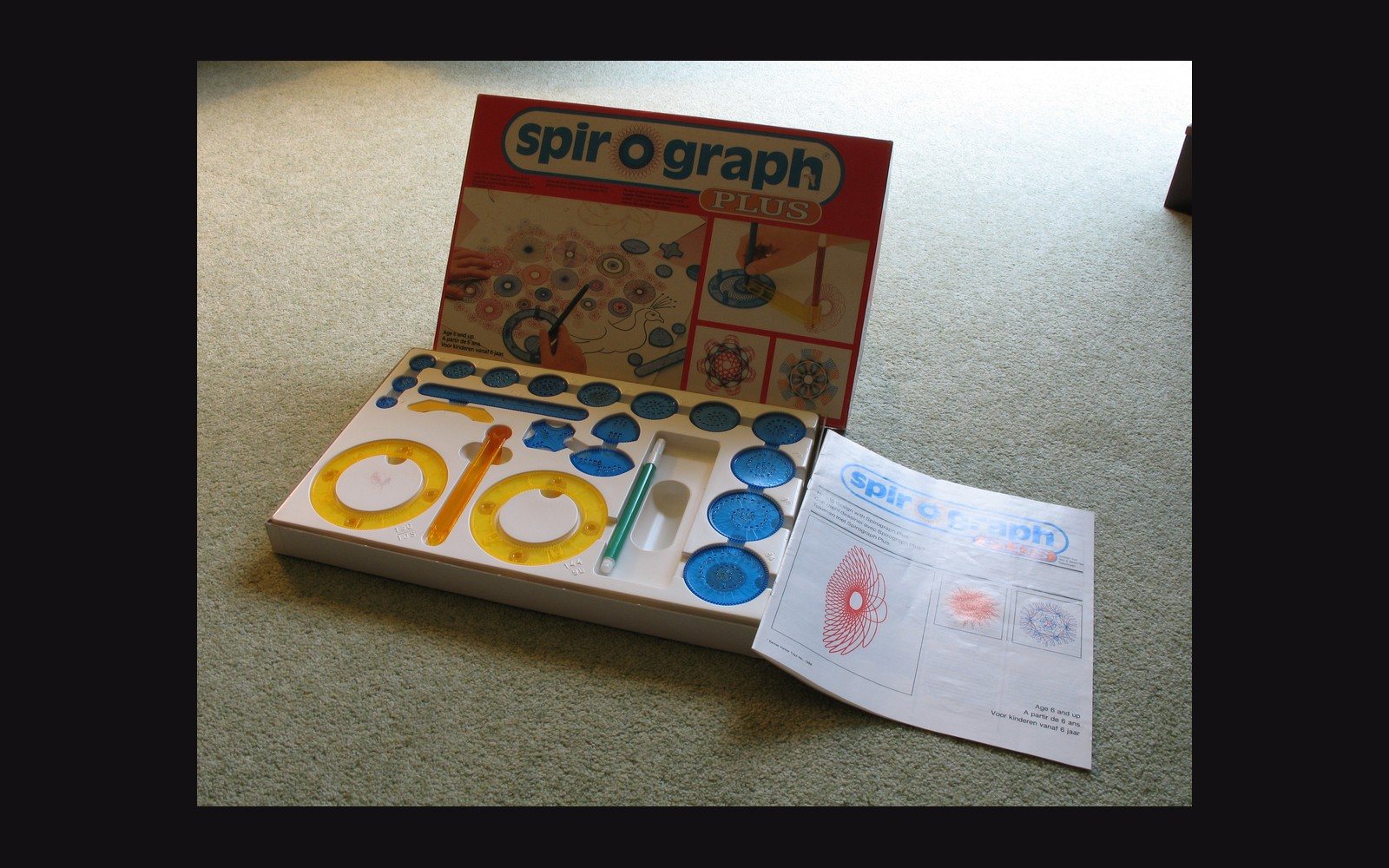
The Patent and the Curves
Denys Fisher, a British engineer, filed his patent for the Spirograph drawing toy in 1965, describing a system of toothed plastic rings and discs whose interaction traces continuous, closed mathematical curves on paper. The governing geometry had been formalised long before Fisher's invention: when a small circle rolls around the interior of a larger fixed circle, any point on the smaller circle traces a hypotrochoid ↗; when it rolls around the exterior, it produces an epitrochoid. Fisher's patent translated that theorem into a consumer object by cutting gear teeth into the edges of both elements, constraining the rolling motion to discrete, repeatable steps and anchoring the outer ring to the page with small pins.
The ratio of the two gear counts — teeth on the inner disc against teeth on the outer ring — determines how many petals or lobes the finished curve carries and whether it closes after one revolution or many. A disc with 60 teeth running inside a ring with 96 produces a pattern that completes after five full circuits; change one disc for another with 80 teeth and the curve changes entirely. Fisher supplied a set of discs and rings with different tooth counts precisely to exploit that arithmetic, making the combinatorial range of possible patterns far larger than the physical component count would suggest.

Nuremberg and Kenner
Fisher exhibited the Spirograph prototype at the Nuremberg Toy Fair in 1965. Kenner Products, the Cincinnati-based American toy firm, saw it there and licensed the design; Kenner brought it to the American market in 1966, and it won the Toy of the Year award from the British Association of Toy Retailers that same year. Kenner's version retained Fisher's gear geometry but scaled the packaging and component count to the American mass-market format. Hasbro eventually acquired the Kenner brand and with it the Spirograph trademark, which remains in production.
The physical components — injection-moulded in hard plastic, dimensionally consistent enough that the gear teeth mesh without slip — demonstrate how tightly manufacturing tolerance and mathematical outcome are coupled in the toy. A disc warped by heat or inaccurately moulded produces a skipped tooth, and a skipped tooth breaks the curve's closure. The Spirograph is, in that sense, a precision instrument wearing the livery of a children's toy: its geometry works only because the tooling holds.